


EU Code Week with Matific – How Does Algorithmic Thinking Connect with Maths Learning?
What does coding have to do with maths? More than we might initially think! Recognising patterns, breaking problems down into smaller steps and developing problem-solving strategies play an important role in both areas. Developing algorithmic thinking is not limited to computer science lessons: it can begin in early childhood and be incorporated across a wide range of subjects.
In 2026, Matific Hungary joined EU Code Week for the first time. Throughout the campaign, 663 students from 41 Hungarian schools completed a total of 17,603 maths activities on Matific’s game-based learning platform.
As part of the initiative, we spoke with Attila Főző, Hungary’s EU Code Week Lead, about the importance of developing algorithmic thinking, its connection to mathematics and the role educators can play in fostering these skills.
Algorithmic thinking goes beyond computer science lessons
EU Code Week is a European initiative that aims to promote coding, computational thinking, problem-solving and the development of digital skills. Schools, educators and educational organisations across Europe participate in the programme through a variety of activities and events.
According to Attila Főző, algorithms are as old as humanity itself and continue to be part of our everyday lives. The development of algorithmic thinking begins in early childhood. Preschool children, for example, learn to control floor robots while completing different tasks.
When learning maths, children also encounter numerous problems that require them to recognise patterns and break tasks down into smaller steps. Algorithms essentially represent the pathway to a solution, which is why they are relevant not only to mathematics but also to other subjects.
For more than a decade, EU Code Week has been raising awareness of the importance of developing computational and algorithmic thinking.
Just as the development of reading comprehension, mathematical competency and critical thinking is not limited to a single subject, problem-solving using digital tools and algorithms can be incorporated into a variety of learning contexts.
Through programmes organised around the world, practical examples and best practices, the initiative supports educators who are interested in exploring these approaches.
Matific at EU Code Week: three weeks of game-based maths learning
In 2026, Matific Hungary participated in EU Code Week for the first time. Our aim was to demonstrate how mathematical problem-solving can be connected with the development of algorithmic and logical thinking.
As part of the initiative, from 10 to 25 October, we provided free access to Matific for schools and educators who had not previously used the platform.
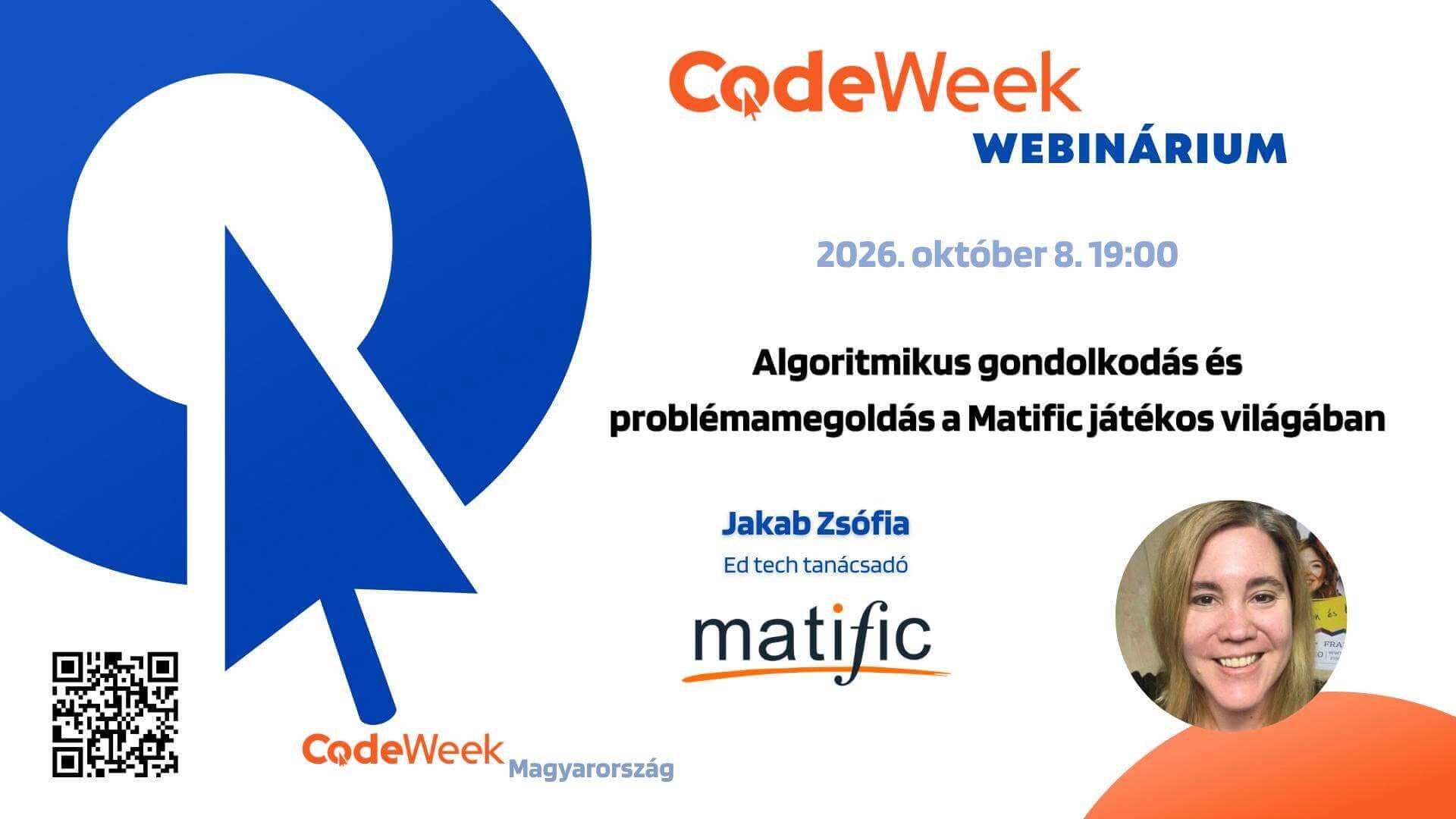
The programme also included a dedicated teacher webinar, in which Zsófia Jakab from Matific explored the connection between algorithmic thinking, problem-solving and Matific’s game-based maths learning environment.
The webinar was titled Algorithmic Thinking and Problem-Solving in Matific’s Game-Based World. Watch the webinar recording here.
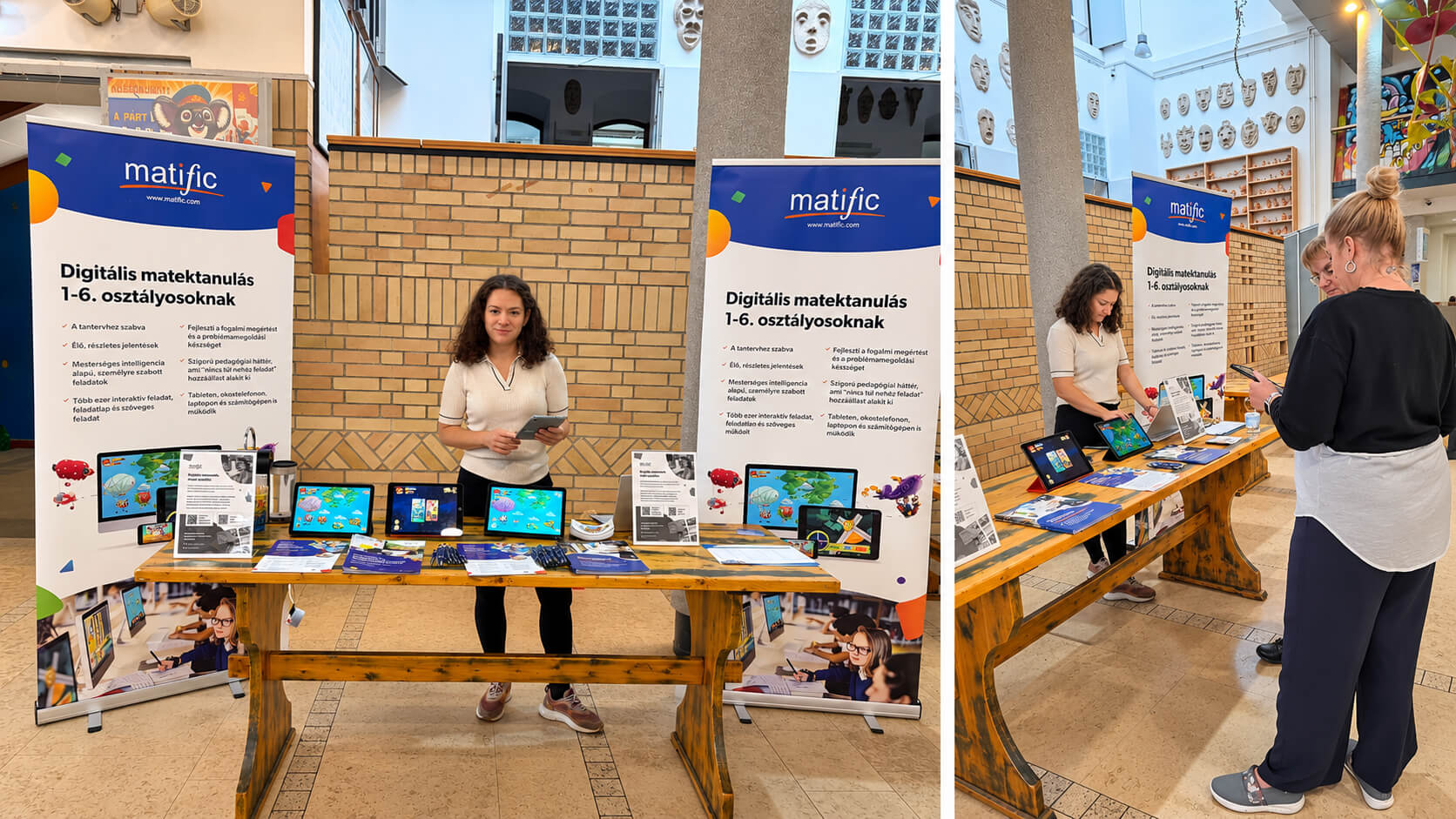
Matific also showcased its platform at Hungary’s EU Code Week conference, where we had the opportunity to connect with educators interested in digital pedagogy and the development of computational thinking.
More than 17,000 maths activities completed
The results of our first EU Code Week campaign in Hungary were encouraging. The campaign gave hundreds of students the opportunity to explore Matific’s game-based maths activities, while educators had the chance to become familiar with the platform.
Congratulations to the winning schools!
As part of the campaign, three educational institutions were awarded Matific subscriptions:
-
Székesfehérvári Kossuth Lajos Általános Iskola – a 12-month Matific subscription
-
Tiszaroffi Baptista Általános Iskola és Óvoda – a six-month Matific subscription
-
Szent Anna Katolikus Óvoda és Általános Iskola – a six-month Matific subscription
Congratulations to the winners, and thank you to all participating educators and students for their enthusiasm and active involvement!
Working towards shared educational goals
According to Attila Főző, it is both important and encouraging when organisations working towards shared educational goals collaborate. He values the support of internationally recognised digital learning platforms such as Matific for the principles championed by EU Code Week.
The shared goal of this collaboration is to support children’s development and expand their knowledge. This is particularly important in a world being transformed by artificial intelligence, where thoughtful pedagogical approaches play a crucial role in improving education.
For Matific, joining EU Code Week also represents an opportunity to introduce more educators to the possibilities of game-based maths learning.
Szilvi Koleszár, Matific’s Education Lead in Hungary, shared her perspective:
“The responsibility of educational technology companies does not end with the development of digital tools. Equally important is supporting educators in turning these tools into meaningful educational experiences.
We joined EU Code Week because we believe that developing mathematical thinking, algorithmic thinking and problem-solving skills is a shared responsibility. Through Matific, we want to demonstrate that these skills can be developed through play from an early age, without necessarily requiring coding.
It is particularly important to us that initiatives like these make innovative teaching methods accessible to more educators and schools, regardless of their previous experience with digital education.”
Educators’ openness to learning is key to progress
According to Attila Főző, one of the most important qualities an educator can have is an openness to continuous professional growth. Digital technology is now present in almost every aspect of life, and our rapidly changing world encourages lifelong learning.
Hungary’s EU Code Week ambassadors therefore encourage educators to experiment with confidence, explore new teaching methods and seek out professional communities where they can learn from one another.
Educators do not need to be computer science teachers to do this. Developing problem-solving skills, mathematical competency and critical thinking can play an important role in every educator’s practice.
Mathematics is more than calculations
At Matific, we believe that learning maths is not simply about finding the correct answer. Equally important is the journey children take to reach a solution: recognising connections, exploring different strategies and breaking problems down into manageable steps.
EU Code Week 2026 provided an opportunity to introduce this approach to more schools and educators across Hungary.
We look forward to working with even more educational institutions in the years ahead to make maths learning engaging, motivating and intellectually stimulating for every child.
Would you like to try Matific with your class?
Discover the possibilities of game-based maths learning on the Matific Hungary website, or watch our EU Code Week teacher webinar.