

From the Mountains to the City: Mendoza Seeks to Transform the Way Mathematics is Learned
The province has combined assessment, teacher training, and digital platforms to personalize learning and reduce learning gaps.
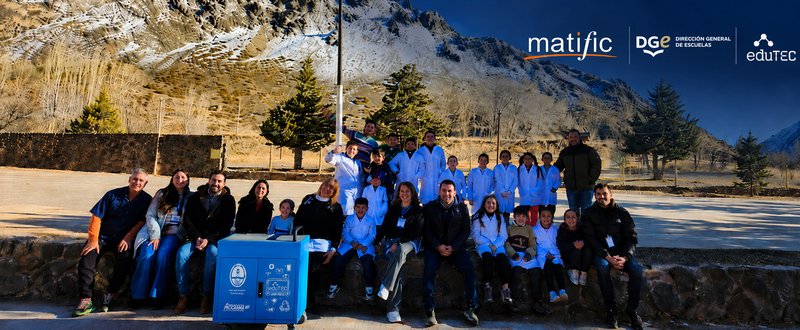
At Río Blanco School 1-558, near Potrerillos, 14 students share multigrade classes in the heart of the Mendoza mountains. With two teachers and connectivity that sometimes requires solving problems on the go, second- and third-grade students have already completed more than 2,300 mathematics challenges covering numeracy, sequences, and geometry. Meanwhile, at 25 de Mayo School 1-025 in San Rafael, 358 students and 15 teachers work on topics ranging from fractions and decimals to algebra, equations, and geometry, with more than 18,600 challenges completed.
These two experiences—one rural and multigrade, the other urban and with a large student population—capture Mendoza’s vision: where a student lives should not determine their opportunities to learn mathematics.
A Policy That Starts with Measurement
The provincial policy has placed mathematics among the priorities of the education system, building on the experience of the Provincial Literacy Plan: measuring regularly, identifying where the difficulties lie, and taking targeted action.
As part of this approach, Matific was introduced into Mendoza’s classrooms. Matific is a gamified mathematics learning platform powered by artificial intelligence. Through games, avatars, rewards, and progressive challenges, the platform aims to strengthen conceptual understanding, critical thinking, and problem-solving skills, while also fostering a closer and more confident relationship between students and mathematics.
The platform adapts activities to each student’s starting point and pace of learning, while providing teachers with information and reports to identify difficulties, monitor students’ learning journeys, and adjust their teaching strategies.
For the province, tools such as Matific provide access to a student-level data system that makes it possible to track each student’s performance, identify specific learning difficulties, and direct resources toward the schools, grades, and classes that require greater support. The Ministry also monitors levels of use and adoption among teachers and students, connectivity conditions, and differences across schools and contexts. This information helps refine initiatives, strengthen teacher training, and determine when a program is ready to be scaled.
To understand the tool’s actual contribution to learning outcomes, the province has promoted continuous internal and external assessments since the beginning of the project. Field reports show that results are neither automatic nor uniform. Rather, each school’s context, the level of adoption among teachers and students, frequency of use, and local implementation conditions are key factors determining the success of the initiative.
In southern Mendoza, the experience of these schools reflects the value of incorporating new technologies that place students at the center of learning. Mariana Carboneti, Principal of 25 de Mayo School 1-025 in San Rafael, highlighted the positive impact of implementing the platform in her school community:
“At our school, the incorporation of the Matific platform has been a highly positive experience for strengthening mathematics learning. As a leadership team, we particularly value the way the platform promotes learning through play, logical thinking, and problem-solving, contributing to the development of essential skills for the 21st century.”
For Mendoza’s Minister of Education, Culture, Childhood and DGE, Tadeo García Zalazar, this conclusion reinforces a central principle of the provincial model: technology only makes sense when it serves a pedagogical purpose, is supported by teacher training and mediation, and generates evidence that can be used to improve learning outcomes.

Matific enables the province to track each student’s progress, identify learning difficulties and direct resources where they are needed most.
Scaling with Evidence
The experience, which began as a pilot program and expanded to additional schools, confirmed that technology needs to be integrated into pedagogical planning and supported by teacher training, connectivity, devices, and other resources that enable sustained use.
The province’s ambition goes beyond introducing a platform or improving a single indicator. Mendoza seeks to combine assessment, teacher training, educational materials, and digital tools to strengthen learning and reduce inequalities.
Recent results from the Aprender assessments placed the province above the national average and, according to García Zalazar, showed a reduction in learning gaps between public and private schools, as well as between urban and rural schools. While these improvements cannot be attributed to a single tool, Matific is part of a broader strategy that uses evidence to identify needs, adjust interventions, and determine how they can be scaled.
For García Zalazar, the value of the experience lies in combining mathematics education, technology, and coordinated efforts between government, schools, and educational platforms. Through play and learning environments that feel familiar and engaging to students, the approach encourages greater motivation and participation in the classroom.
According to the minister, the results are particularly encouraging among students who start with lower levels of achievement, who show progress that can be even faster than that of students who are already at advanced levels. This ability to engage all students—also recognized by teachers and school leadership teams—strengthens Mendoza’s ambition to make mathematics an accessible tool and an opportunity for development.