

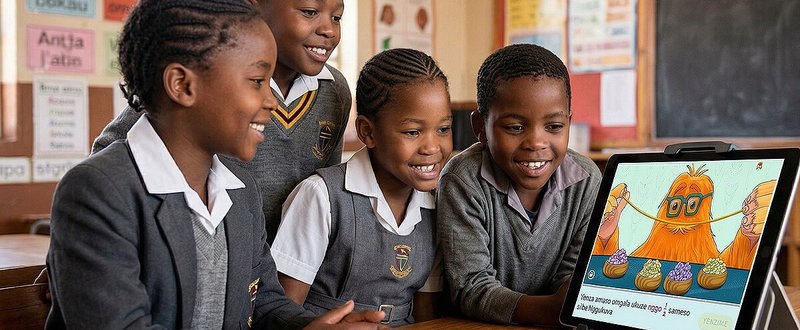
Mother tongue maths programme launched to support foundational learning in South Africa schools
A partnership between Matific, the Eastern Cape Department of Education and Click Learning is rolling out an isiXhosa maths learning experience to strengthen foundational numeracy in South Africa’s classrooms
South Africa’s education system continues to face a deepening foundational learning crisis, with only three in ten early grade learners able to read at the expected grade level. Literacy challenges are unchanged and increasingly linked to poor performance in subjects like mathematics, where comprehension plays a critical role.
IsiXhosa is one of the most widely spoken home languages in South Africa, used by an estimated 16% to 20% of learners. While figures vary, it remains a dominant language of instruction for millions of children, particularly in the Eastern Cape and Western Cape.
In response to this, a new initiative is introducing digital maths learning in isiXhosa in Eastern Cape classrooms, aimed at improving conceptual understanding by teaching concepts in the language learners know best.
The programme is being implemented in partnership with Matific, a global digital maths learning platform, alongside the Eastern Cape Department of Education and Click Learning, a South African non-profit organisation focusing on improving foundational literacy and numeracy outcomes through the use of Edtech.
The roll-out combines curriculum-aligned digital content, voice-enabled accessibility features, and AI-supported localisation infrastructure, alongside a structured implementation model designed for real classroom use. It reflects a shared commitment to improving early grades learning outcomes by making mathematics more accessible in learners’ mother tongue language.
The isiXhosa language used in the programme has been approved by the Pan South African Language Board (PanSALB), ensuring alignment with national language standards and supporting quality-assured localisation for use in public education systems.
The launch aligns with South Africa’s growing focus on multilingualism and Mother Tongue-based Bilingual Education (MTbBE) and has now begun with a pilot in selected schools in April 2026, with the aim of refining implementation before broader roll-out.
This will be followed by a phased activation among additional schools, with insights from early implementation used to refine its delivery.
“South Africa’s focus on multilingual learning is a powerful opportunity to strengthen foundational numeracy outcomes,” said Craig Shotland, CEO of Matific. “By localising Matific into isiXhosa while maintaining pedagogy and curriculum alignment, we’re helping more learners access maths concepts in the language they understand best, while supporting teachers with structured, data-informed instructional tools.”
How a locally grounded approach can unlock scalable implementation in our schools
The isiXhosa experience has been developed to ensure it is aligned with curriculum needs and works effectively in real classroom situations.
The Eastern Cape Department of Education versioned the student activities into isiXhosa, supported localisation and curriculum alignment, while Click Learning is leading school rollout through structured delivery, technology infrastructure, and ongoing monitoring. Matific contributes its pedagogy-first platform and the infrastructure required for high-quality localisation and scalable expansion into additional languages.
This builds on Matific’s proven experience in South Africa through Click Learning’s programme, where the platform has demonstrated strong learner engagement across 3 provinces
“This is an important step forward in how we deliver numeracy in South Africa. While learners are already taught in their home language, there are still very few high-quality, curriculum-aligned maths tools available in African languages. What this enables is the use of personalised edtech in isiXhosa, helping learners engage with maths concepts in a way that is both accessible and responsive to their level.
For us, the focus is not just the tool, but how it is integrated into a structured implementation model that fits into the system and works in real classrooms at scale,” said Dylan Harrison, COO of Click Learning.
How AI-enabled teacher and WhatsApp experiences are extending support beyond classrooms
Matific’s AI features help educators act on learner data and strengthen engagement with families. The programme also uses accessible digital tools to support teachers and keep learners engaged beyond the classroom, including familiar platforms like WhatsApp.
This approach positions technology as a capacity multiplier for teachers and education systems, rather than a standalone intervention.
What a scalable model for multilingual education could look like
Looking ahead, the initiative signals a broader opportunity to strengthen learning outcomes across South Africa by making education more accessible in learners’ home languages.
While the current rollout focuses on isiXhosa, the long-term vision is to expand this approach into additional African languages, helping more learners engage with mathematics in a way that feels familiar, relevant, and easier to understand. With education systems continuing to prioritise foundational learning, initiatives like this offer a practical step toward more inclusive and effective classrooms.
For more information on programme roll-out, visit www.matific.com