

Statewide Government Assessment Confirms: Greater Matific Usage Linked to Higher Math Achievement
The strongest Mathematics performance in São Paulo’s public education system in nearly 30 years highlights the impact of data-informed education policies and demonstrates how technology, when meaningfully integrated into teaching and learning, can function as a learning infrastructure at scale.
A milestone for public education in São Paulo
The 2025 results of SARESP, São Paulo State’s large-scale student assessment, mark a historic moment for public education in Brazil. The state recorded its highest Mathematics performance since the assessment began nearly three decades ago, with consistent improvements across Grades 2, 5, and 9, growth in proficiency levels, and a significant reduction in students performing below baseline expectations.
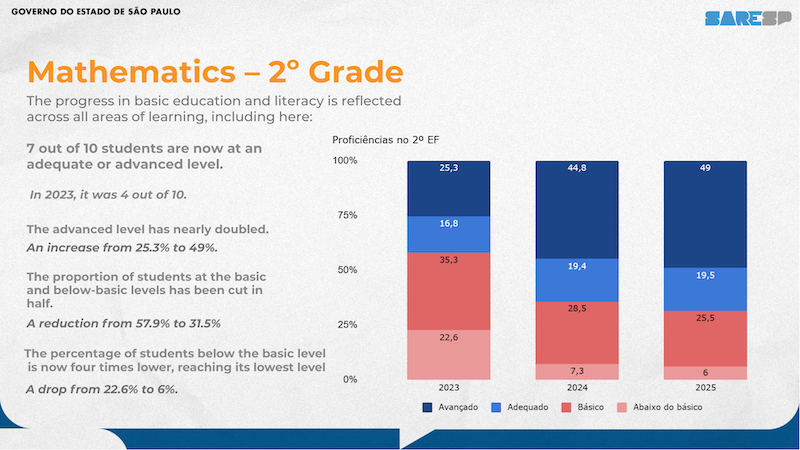
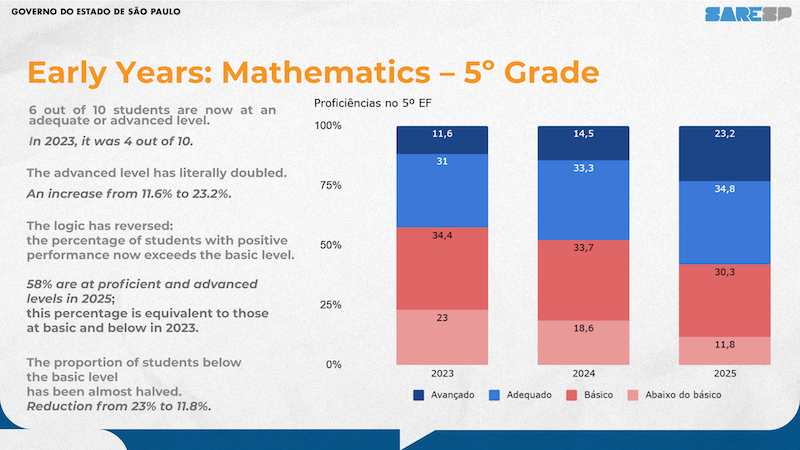
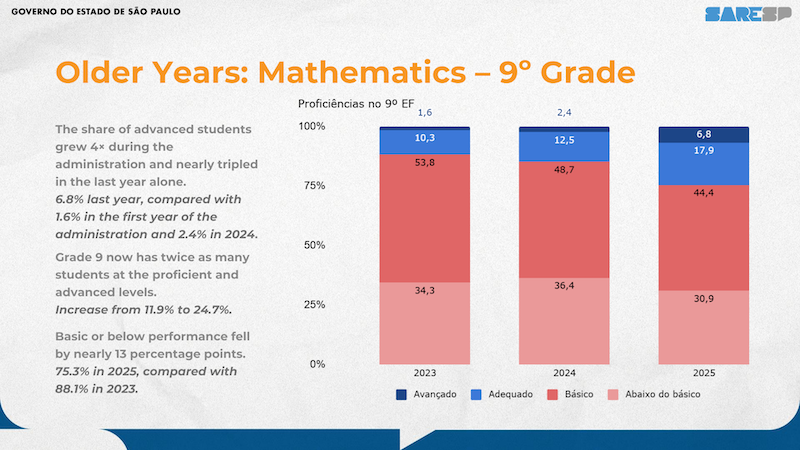
The results were officially presented during a government press conference at Palácio dos Bandeirantes, the headquarters of the State Government, attended by Governor Tarcísio de Freitas and Education Secretary Renato Feder. Officials emphasized that the progress reflects a structured education strategy guided by evidence and continuous monitoring.
Beyond celebrating improved scores, the announcement signaled something broader: the consolidation of an integrated, system-wide approach to learning improvement across one of the largest public school systems in the world.
A data-informed education strategy
The improvement in Mathematics outcomes did not result from a single initiative. Instead, it reflects a coordinated set of policies including structured curriculum design, clear learning targets, ongoing pedagogical support, teacher professional development, and continuous performance monitoring.
Within this broader ecosystem, technical analysis conducted by the Secretaria da Educação do Estado de São Paulo identified a notable finding: a positive correlation (0.42) between consistent use of the Matific platform and school performance in Mathematics.
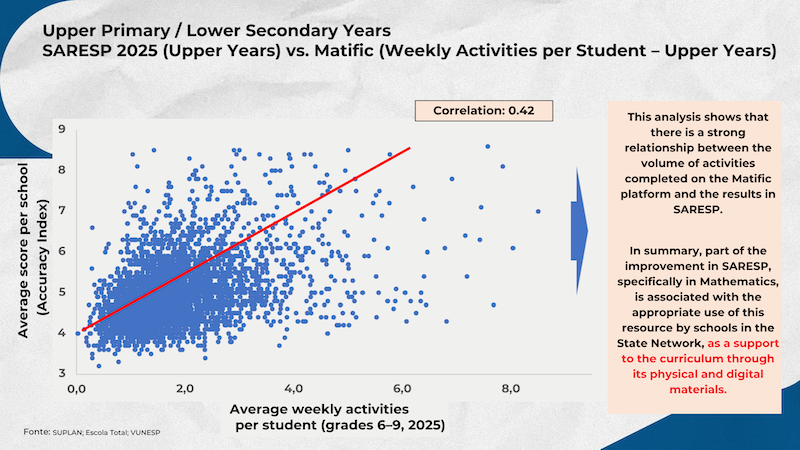
In practical terms, schools with higher levels of platform usage achieved significantly stronger results in the SARESP assessment.
During the official presentation, the governor publicly referenced this relationship, noting that classrooms with higher engagement levels with the platform demonstrated stronger Mathematics performance. At the same time, he emphasized that the historic improvement resulted from a comprehensive set of policies, including expanded full-time schooling, continuous teacher training, tutoring programs for learning recovery, improvements in instructional materials, attendance monitoring, and strengthened early literacy initiatives.
This context is essential. Technology appears not as a standalone solution, but as one component within an integrated education strategy.
Evidence at the system scale
Because SARESP is a census-based assessment covering the entire state network, statistically significant correlations gain additional strategic relevance. The association between consistent technology usage and improved outcomes emerges in the same year that São Paulo achieved its strongest Mathematics performance in approximately 30 years.
This does not imply isolated causality. Rather, it highlights a consistent association within a coordinated public policy framework that produced the highest performance ever recorded in the assessment.
Large-scale evidence of this nature remains rare in education systems worldwide. São Paulo’s case therefore offers not just local success, but globally relevant large-scale evidence.
Around the world, education systems are increasingly exploring how structured digital learning tools can support large-scale improvement when aligned with curriculum and classroom practice. Matific is working with governments and education systems in initiatives spanning California, Brazil, New Zealand, Ukraine, Uruguay (Plan Ceibal), Hungary, and school districts across Canada and the United States and many more, as well as collaborations with UNICEF in countries such as Ghana, Egypt and Honduras.
From digital tool to learning infrastructure
São Paulo’s experience reinforces a growing global understanding: educational technology drives impact when it is integrated into curriculum and pedagogy rather than used sporadically.
The 2025 results reflect years of coordinated implementation, particularly in lower secondary education. Measures included expanded instructional time in Mathematics and Portuguese, curriculum prioritization, improved digital and print learning materials, bi-monthly assessments, and teacher training aligned with instructional goals.
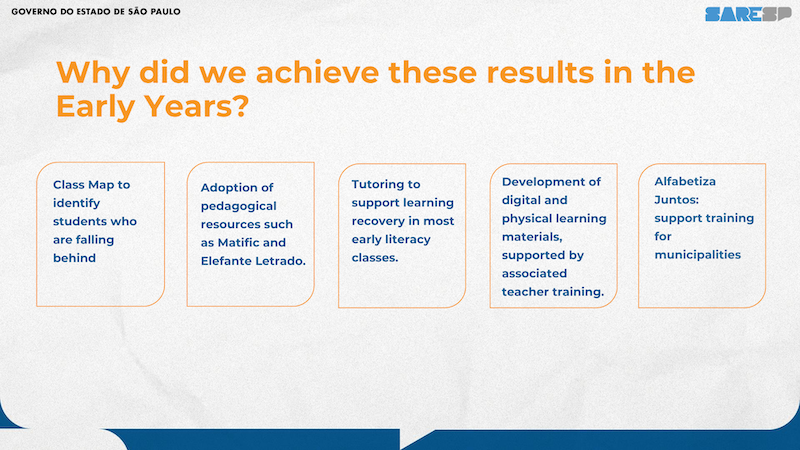
These initiatives were complemented by structured learning recovery programs and the systematic adoption of digital learning resources, including Matific, embedded within classroom practice.
The key insight is clear. Technology becomes effective when it moves beyond occasional use and becomes part of a coherent instructional architecture.
Learning infrastructure implies consistent, predictable use aligned with pedagogical objectives and supported by data and policy continuity. In this context, technology shifts from being complementary to becoming structurally embedded in everyday learning.
Scaling quality
Achieving isolated improvements is important. Achieving system-wide progress across millions of students is transformative.
São Paulo’s historic Mathematics results demonstrate that scale and quality can advance together when education systems combine evidence-based policymaking, continuous monitoring, and integrated pedagogical tools.
In a global context still addressing pandemic-related learning gaps, large-scale evidence offers valuable insights for education systems, policymakers and school leaders worldwide.
A collective achievement
These results reflect the combined efforts of policymakers, school leaders, teachers, and students across the state network.
They reinforce an important lesson: sustainable education transformation emerges not from isolated interventions, but from alignment between public policy, pedagogical practice, and thoughtfully implemented technology.
São Paulo’s experience sends a clear message. When educational technology is meaningfully integrated into teaching and learning, it can act as a real accelerator of learning at scale.
More than a strong assessment outcome, this represents an example of institutional maturity and a pathway for education systems seeking sustainable improvement.