

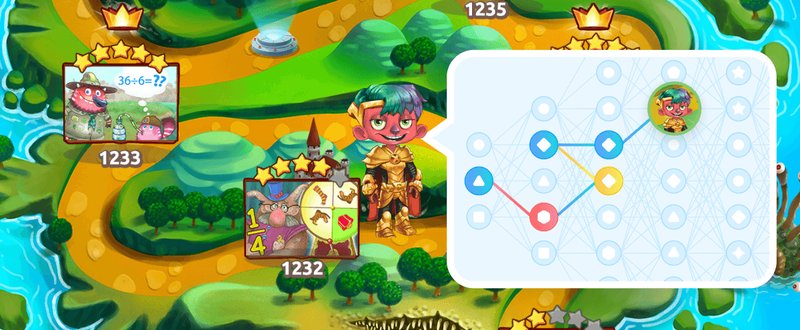
How Matific AI Delivers Personalised Learning on Adventure Island
Go behind the scenes of our most intelligent activity sequencing model.
At Matific we get questions about activity sequencing all the time. What’s the best way to sequence our activities? Our solution is Adventure Island.
Every time a student steps into Adventure Island, they begin a learning journey that’s crafted just for them, based on their strengths, struggles, and learning style. But adventure island isn’t just recommending students complete easier or harder activities.
Behind the scenes, a smart adaptive algorithm is hard at work, making sure that every activity your student sees is the right one, at the right time, always delivering that perfect balance of engagement, and learning progression.
How we select each activity
We don’t believe in static learning pathways or one-size-fits-all practice sets. Every activity in Adventure Island is carefully selected by our adaptive algorithm, which uses historical performance, curriculum pacing (focus) and engagement data to personalize each student’s learning path.
What’s an adaptive algorithm?
An adaptive algorithm is a type of artificial intelligence that adjusts automatically based on the data it's exposed to. This means that it learns something new every time a student attempts or completes an activity, even in other learning zones, and adjusts its recommendations based on these new insights.
When selecting the perfect next activity, we have a lot of priorities to balance:
- It needs to serve a purpose in the student's learning journey; such as helping a student discover a new topic, develop their conceptual understanding or practice and build fluency.
- It needs to keep the student engaged and learning.
- It needs to be aligned with the class's curriculum pacing and the curriculum a teacher is using.
To achieve the right balance we use a system of weightings for each activity;
- Curriculum pacing: What learning goal has the teacher set for the class? With the Focus Topic feature, teachers can highlight the exact topics they want students to master. The algorithm then adjusts its recommendations to prioritise activities that build toward that goal, while still adapting to each student’s individual needs.
- Knowledge streams: Does this activity help a student discover a new topic, build conceptual understanding or develop fluency? And if they are struggling to learn a new topic, what pre-requisite skills might they need to develop further to be successful.
- Accuracy prediction: How well is the student likely to perform on this activity? This helps us strike the right balance between challenging students and building their confidence.
- Engagement: We want students to stay curious and excited, so the algorithm mixes things up with fun, fresh, and varied activities that keep learning.
We provide the recommendation algorithm with a robust set of instructions for how it should consider these weightings in different contexts. These instructions include information about how to support a student that is struggling with a topic, what to do when a student is showing disengagement, or how to introduce a new topic.
Designed with pedagogy first
Matific pedagogy is at the core of everything we do. We want students to really understand the why behind mathematical concepts and enjoy the journey.
This is why our learning design teams mapped out knowledge streams for every topic. A knowledge stream is a sequential order that students should learn each concept; from pre-requisite skills they may need to master through to building conceptual understanding and then fluency.
To master division, for example, we take students from their prerequisite knowledge of subtraction, and begin connecting sharing to small-number division, gradually shifting a student from concrete to abstract thinking.
The magic though is every student learns at a different pace, one student may need three activities on sharing to really begin to understand the concept of division, another student will see that connection right away. So although the pacing and order of what activity a student may see changes, the algorithm respects the knowledge steam pacing every time.
Fast-forward checks
As we’ve evolved Adventure Island, we’ve learned how important it is to give students the chance to demonstrate what they already know, especially when that learning might have happened outside of Matific, like in the classroom or at home.
To support this, we’ve introduced “fast-forward” moments: low-risk challenges that check if a student is ready to skip ahead. If they succeed, the algorithm adjusts their learning path and moves them forward through the curriculum. This helps avoid repetitive fluency tasks for students who have already mastered a concept, keeping their learning journey efficient, relevant, and motivating.
The most intelligent adaptive learning
Today, Adventure Island’s adaptive algorithm has reached 82% prediction accuracy. That means we can forecast how well a student will perform on an activity before they even begin.
And it’s only getting smarter. We’re developing features like:
- Abort prediction, to help prevent students from dropping off
- Motivational nudges, that re-engage students with a fun activity at just the right moment
And for teachers? Our system delivers Mastery Reports, Readiness Predictions, and a powerful Focus Topic tool, so you can support every student, without assigning every activity by hand.
Together, these innovations help ensure every child learns at the right pace, with just the right level of support—giving teachers clearer insights and students a more confident, enjoyable path through maths.