

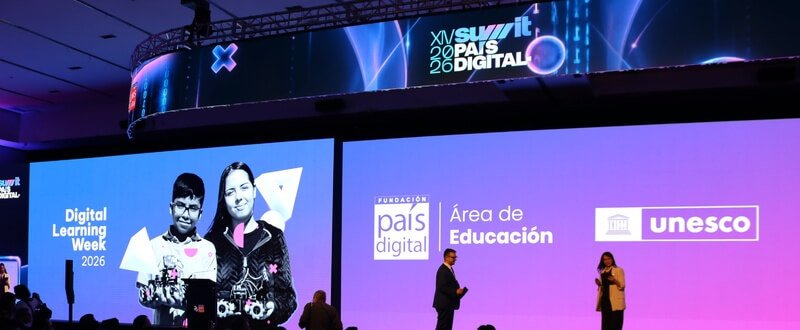
Matific at the XIV País Digital Summit: teaching and learning with artificial intelligence
As part of LAC Digital Learning Week, Matific joined a dialogue in Santiago, Chile, convened by UNESCO Santiago and Fundación País Digital, with a focus on teaching practice and mathematics learning.
How can artificial intelligence strengthen teaching and support each student’s learning needs? This question shaped Matific’s participation in LAC Digital Learning Week, held within the framework of the XIV País Digital Summit. Co-organised by the UNESCO Regional Office in Santiago and Fundación País Digital, the event connected international discussions on education and artificial intelligence with the realities of Latin America and the Caribbean.
For Matific, taking part in this conversation meant sharing a belief that guides our work with schools and governments across the region: educational innovation is meaningful when it helps teachers teach and students learn with confidence.
New frontiers for teaching practice
Pablo Donoso, representing Matific, took part in the session ‘New frontiers for teaching practice: teaching and learning with AI’, alongside Darío Riquelme from the University of Chile and Alejandra Meza from Red EdTech.
During the discussion, Donoso explored the potential of artificial intelligence to support mathematical reasoning, critical thinking and personalised learning. The conversation highlighted the role of teachers and the pedagogical decisions that guide the integration of these tools into the classroom.
Learning mathematics with understanding and confidence
At Matific, we believe that learning mathematics involves exploring, testing strategies, recognising mistakes and developing solutions. When considering the contribution of artificial intelligence, we therefore focus on the opportunities it can create to support these processes.
Personalising learning requires recognising that students in the same classroom bring different levels of prior knowledge, learn at different paces and have different needs. Access to relevant information can help teachers identify difficulties, select appropriate challenges and decide when to offer additional support.
A clear educational purpose guides each of these decisions: what we want students to understand, which experiences can help them move forward and how to recognise their progress. From this perspective, technology adds value when it helps create better learning opportunities.
The future of EdTech and foundational learning
During the event, we had the pleasure of exchanging insights with Dr Valtencir Mendes, Chief of Education at the UNESCO Regional Office in Santiago, on the future of EdTech and foundational learning.
We are sharing his video testimonial to continue the conversation about how innovation can support the development of the knowledge and skills that underpin learning.
▶ Watch Valtencir Mendes’ video testimonial:
A regional conversation built on collaboration
Integrating artificial intelligence into education raises questions that call for the participation of teachers, institutions, governments and organisations across the education sector. Access, professional learning and the suitability of tools need to be considered in the context of each community.
Our participation in this event reaffirms Matific’s commitment to this dialogue. We thank UNESCO Santiago and Fundación País Digital for creating a space to share experiences and reflect on the future of education across the region.
We continue working to help more students develop their mathematical skills with curiosity and confidence, and to provide teachers with tools that support their practice.
Would you like to discover how Matific can support your school or education system?