

When Learning Mathematics Also Means Playing, Experimenting and Making Mistakes
Teachers across the province of Córdoba are incorporating challenges and digital tools to transform the experience of learning Mathematics and create new ways of teaching in the classroom.
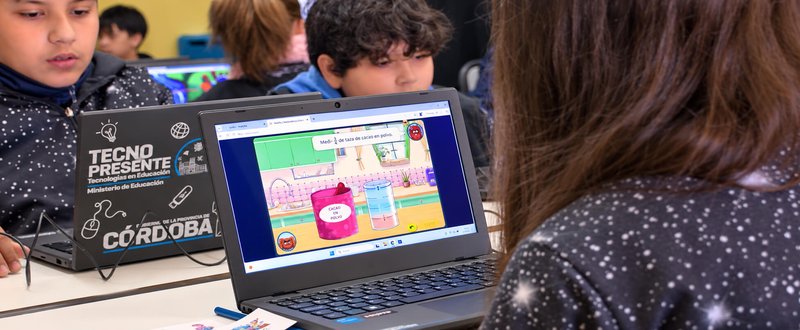
Since she began using Matific with ten classes at Presidente Hipólito Yrigoyen School in San Francisco, something has changed for teacher Belquis Beatriz María Monina: as she puts it, she has become “the most requested teacher.”
“It’s incredible how much the platform draws them in. Every single student interacts with it without fear,” she says. But what surprised her most was seeing the different ways students came up with to solve the challenges: “Many of them surprised me, and many of them taught me shortcuts I had never thought of.”
Her experience reflects one of the challenges facing Mathematics education today: ensuring that learning is not simply about reproducing procedures, but also about exploring, testing strategies, making mistakes and discovering different ways to solve a problem.
“Without a doubt, gamification awakens enthusiasm in students and strengthens the pedagogical relationship. This involves not only their relationship with teachers, but also their relationship with the subject itself—in this case, the learning of Mathematics,”
reflects Gabriela Peretti, Secretary of Innovation, Professional Development and Educational Technologies for the Province of Córdoba.
Across the province, teachers in different communities are incorporating tools designed to create these kinds of learning experiences. One of them is Matific, a game-based Mathematics learning platform powered by artificial intelligence that offers games and challenges focused on conceptual understanding, critical thinking, problem-solving and personalized learning.
A Tool That Supports Teachers
In a single classroom, students learn at different paces and use different strategies. For teachers, supporting these different learning journeys is one of the major challenges they face every day.
Claudia Maldonado, a teacher at José Mármol School in Villa María, uses Matific to complement the content she works on throughout the week.
“The students look forward to the day when they get to work with Matific,” she says. While they complete the activities, she can follow what is happening in real time. “I enter the live class and can see which activity each student is working on,”
she explains.
This information allows her to observe students’ performance as they work and use the platform as a complementary resource within her weekly lesson planning.
The game-based approach adds another dimension. Avatars, challenges, rewards and the opportunity to try again are designed to create an environment where making mistakes becomes part of the learning process, helping students build confidence when facing mathematical problems.
Teaching in New Ways
Digital tools are part of a broader transformation in how Mathematics is taught. The goal is not to abandon operations, formulas or procedures, but to create opportunities for students to understand what they are doing, engage with problem-solving situations and develop their own strategies for solving them.
This also means strengthening the role of teachers. Córdoba has been developing different Mathematics training initiatives and, throughout 2026, has deepened its work on some of the content areas and learning processes that present the greatest challenges in classrooms.
“We want teachers to take away ideas and proposals that they can implement in their day-to-day work,”
explains Laura Vélez, a member of the Mathematics technical team within the Subdirectorate of Curriculum Development and Institutional Support at the Provincial Ministry of Education.
In this context, technology does not replace the teacher. It is a tool that can complement the blackboard, notebooks, peer-to-peer conversations and other teaching strategies. Its value depends on how each teacher integrates it into their lesson planning, which activities they choose and what they do with the information they observe about their students.
From the Classroom to the Results
These experiences are taking place in a broader context in which Córdoba has been showing positive progress in learning outcomes. In the 2025 Aprender assessments, 64.3% of students in Córdoba achieved satisfactory or advanced levels in Mathematics, compared with 55% nationwide.
These results cannot be attributed to a single tool or intervention. They are part of a broader process combining teacher training, curriculum updates, assessment, support for schools, and new pedagogical and technological resources.
“Every improvement in learning is built in the classroom, through the everyday interaction between teachers and students. It is our teachers who, with commitment, creativity and new ways of teaching, make it possible for Mathematics to be understood, enjoyed and transformed into an opportunity to think and learn better. Along this journey, Governor Martín Llaryora promoted the incorporation of Matific as a tool to expand learning opportunities and support teachers and students with new resources for teaching Mathematics,”
said Minister of Education Horacio Ferreyra.
But classroom experiences reveal another dimension—one that is more difficult to capture through an assessment: the relationship children develop with Mathematics as they learn.
Belquis Monina’s experience offers a small glimpse into this. By incorporating a new tool into her teaching, she also discovered students capable of surprising her with ways of solving challenges that she herself had not considered.
The teacher continues to teach, plan and support her students. But students now have more space to explore, experiment and explain how they arrived at an answer.
Because learning Mathematics is not only about finding the correct answer. It is also about understanding why it works, discovering that there may be more than one way to reach a solution, and developing the confidence to keep searching when the answer has not yet appeared.